
Search is no longer limited to ten blue links. Today, users are asking questions directly within AI-powered interfaces such as Gemini, Copilot, Perplexity, and ChatGPT Search. Instead of scrolling, they expect instant, accurate answers. This shift has led many business owners to ask a fair question: Does this mean SEO is dead?
The answer is no. This is evolution, not extinction. At Ralecon, we see the 2026 winning strategy as integrating SEO and AISO. SEO is your digital base. AISO makes your brand the trusted answer in AI-driven search.
In this blog, we will explain how SEO and AISO differ, why they are most effective together, and how using both helps your business stay visible, credible, and competitive within the evolving search ecosystem.
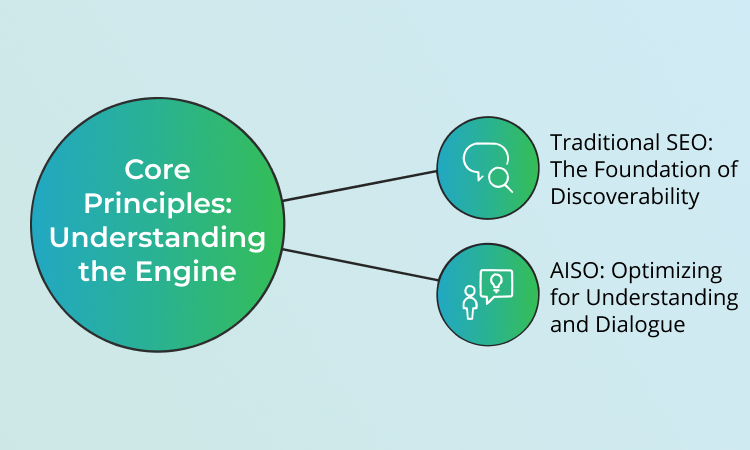
Core Principles: Understanding the Engine
-
Traditional SEO: The Foundation of Discoverability
Traditional SEO focuses on optimizing your website for search engine indexing and ranking algorithms. The goal is simple. Help your pages appear prominently in search results for relevant queries.
This includes keyword research (finding popular search terms), backlink building (getting links from other websites), technical site health (fixing website performance and errors), optimized meta tags (improving page titles and descriptions), internal linking (connecting pages within the site), and structuring content to be easy to navigate. With Google handling over 8.5 billion searches daily, SEO remains crucial for businesses seeking steady inbound visibility.
Strong SEO ensures your content is discoverable, crawlable, and competitive. Without it, even the best content struggles to surface.
-
AISO: Optimizing for Understanding and Dialogue
AISO, or Artificial Intelligence Search Optimization, centers on how AI assistants understand, interpret, and present information. Semantic search means finding results based on meaning and context, not just words. Topical authority refers to expertise in a subject, while trust signals are cues that suggest a source is reliable. These systems depend on these factors more than on keyword density alone.
AISO prioritizes clear explanations, natural language formatting (writing that reads as people speak), structured Q&A sections (organized question-and-answer formats), and strong E-E-A-T signals (showing Experience, Expertise, Authoritativeness, and Trustworthiness). The goal is to become the source an AI assistant selects when generating a direct answer, summary, or recommendation.
Recent studies indicate that over 60 percent of users trust AI-generated answers for informational queries. Such trust is reserved for sources demonstrating credibility, clarity, and expertise.
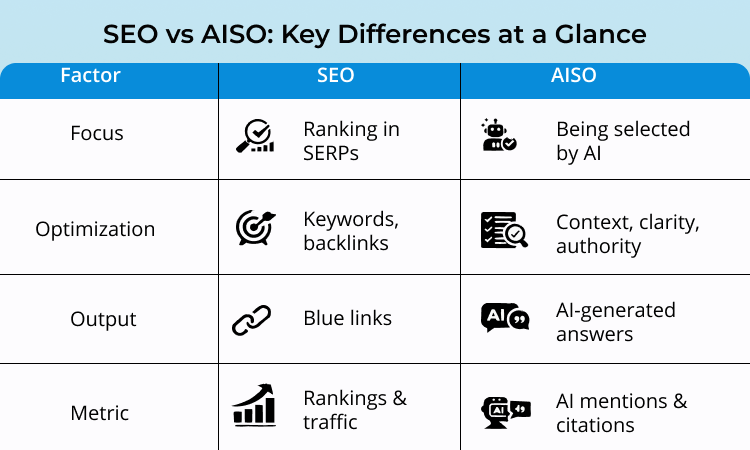
SEO vs AISO: Key Differences at a Glance
The Integrated Strategy: A Synergistic Approach
-
Why They Need Each Other
SEO ensures your content is discovered and indexed. AISO ensures it is selected and cited. Using only one leaf leaves visibility gaps.
Think of SEO as building a well-organized library. Categories are clear, books are indexed, and shelves are easy to navigate. AISO helps your book become the librarian’s top recommendation for questions. With strong SEO, AI systems may never discover your content. If your site lacks AISO, AI may see it but choose another source to answer the user.
-
Ralecon’s Practical Integration Blueprint
As a leading SEO agency in Bangalore, we embed AISO directly into SEO workflows, treating both as elements of a unified strategy.
Each topic addresses target keywords and answers related questions from users and AI. Content is structured with clear section headers to help search engines and with direct answers designed for AI systems. We strengthen content with real experience, performance insights, and case studies built over more than a decade. These trust signals align with Google’s E-E-A-T (Experience, Expertise, Authoritativeness, Trustworthiness) guidelines and AI evaluation patterns.
Technical SEO is foundational. Fast load times, mobile optimization, clean architecture, and structured data affect whether AI trusts and recommends your source.
How to Optimize for Both SEO and AISO?
To stay competitive in 2026, businesses must align content for both search engines and AI systems. This means combining technical strength with conversational clarity. Start by building topic clusters that cover a subject in depth while targeting primary and related keywords. Structure your content with clear headings, concise answers, and FAQ sections that AI tools can easily extract.
Focus on credibility by adding real insights, case studies, and expert perspectives. At the same time, ensure your website performs well with fast loading speeds, mobile responsiveness, and structured data. When your content is both discoverable and understandable, it increases the chances of ranking on search engines and being cited by AI assistants.
Conclusion
The real decision is not SEO or AISO. It is SEO enhanced by AISO. Together, they create a resilient search presence that performs across traditional engines and AI-driven platforms.
An integrated strategy keeps your brand visible whether users are typing queries, speaking to assistants, or viewing AI summaries. Partnering with an experienced SEO agency in Bangalore is now essential, as a modern strategy must integrate algorithms, AI, and user trust.
Ready to secure your search visibility for 2026 and beyond? Contact Ralecon today for a personalized website evaluation and blueprint to strengthen your SEO and AISO strategy.
Is your website ready for AI-powered search in 2026?
Request a comprehensive SEO + AISO audit from Ralecon and discover where your brand stands in traditional and AI-driven search ecosystems.
Frequently Asked Questions
1. Is SEO dead in 2026?
2. What is AISO (Artificial Intelligence Search Optimization)?
3. How is AISO different from traditional SEO?
4. Can small businesses benefit from AISO?
5. How can businesses prepare for AI-driven search in 2026?